




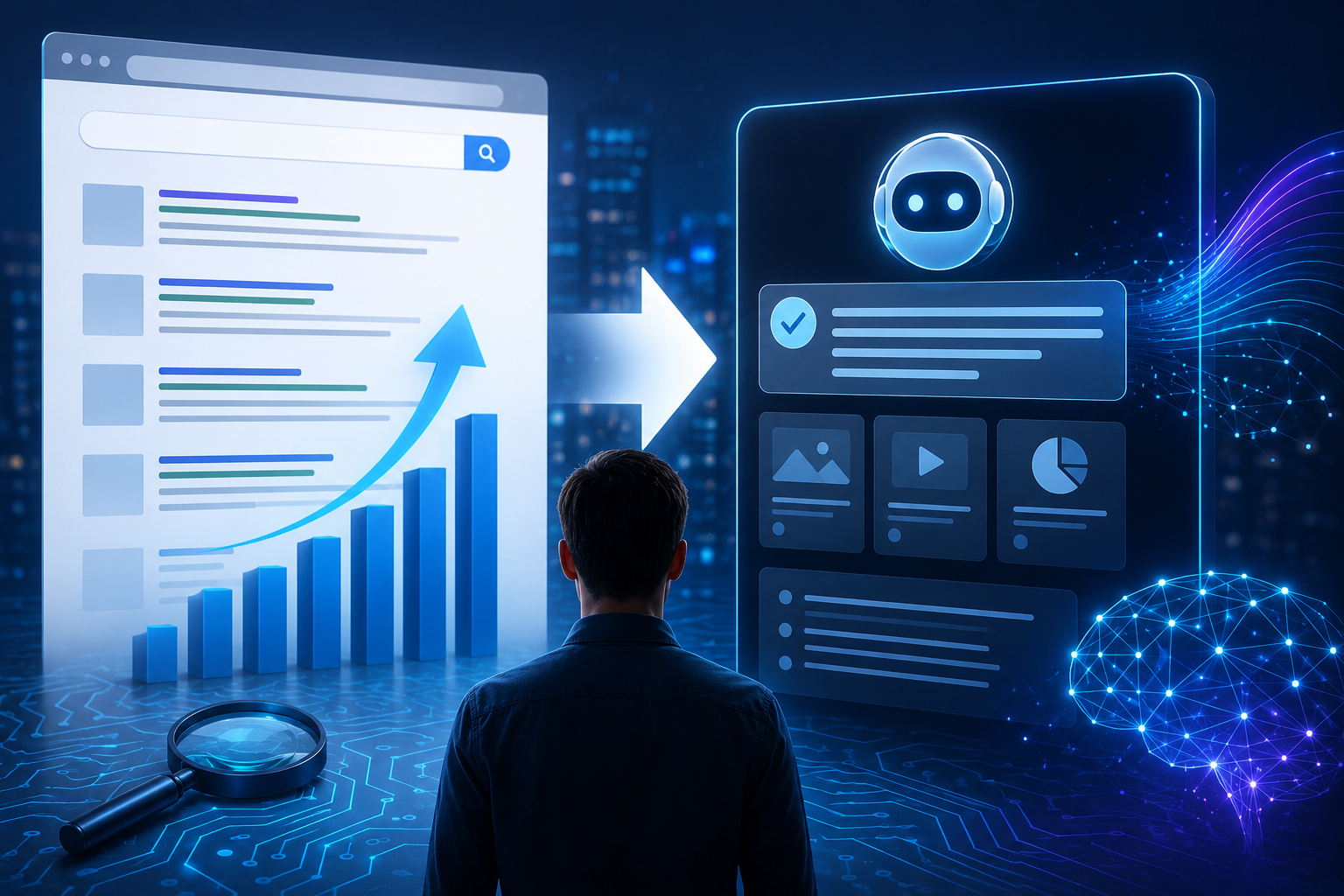
How AI Search is Changing Brand Visibility
The search landscape has shifted. Today’s consumers often get answers directly from AI assistants (ChatGPT, Google’s AI, Bing Copilot) instead of clicking links. Studies show roughly 80% of users rely on “zero-click” AI summaries in at least 40% of their queries, and analysts warn that by 2028, up to half of all searches could be handled by AI.
This means brands that once depended on search rankings must now appear inside those AI answers. As Edelman explains, AI responses act like “opinions, not lists.” If your brand isn’t top-of-mind, it simply won’t appear. In other words, first-place blue links are no longer enough; what matters is being mentioned in the AI-generated reply.
Building on this insight, experts have coined the term Generative Engine Optimization (GEO) to guide brands. GEO involves auditing how AI currently talks about your company and then shaping content so that desired messages surface in AI answers. For example, our team now tracks every AI mention of our brand: we use specialized tools that scan ChatGPT and Google AI Overviews and tally when and where our products, case studies, or experts are cited. In practice, this means combining traditional SEO with new metrics like “AI visibility score,” which measures how often our brand is cited in generative answers.
Tracking AI presence
A new generation of analytics is emerging. Tools such as SE Ranking’s AI Search Toolkit and Brand24’s AI module can automatically crawl ChatGPT, Google’s AI “Overviews,” and other LLM outputs to spot brand mentions.
For instance, SE Ranking explicitly tracks when ChatGPT or Google’s AI includes your brand in an answer. By automating this, marketing teams get an instant view of their “AI footprint,” how many answers mention them and at what prominence, and can benchmark those metrics against competitors. These AI-driven dashboards complement traditional SEO tools, effectively creating an “AI share of voice” metric for brands.
Monitoring earned mentions
With organic web traffic down, earned media (publicity in trusted outlets) has become even more crucial. Edelman reports that up to 90% of the sources AI assistants cite come from reputable news and authoritative websites. In practice, this means generic press blasts or SEO blogs often get ignored by ChatGPT and friends.
AI models will “often bypass ‘press releases without earned pickup’ and other weak content,” instead surfacing high-authority sources. For example, one PR analysis found that low-quality press releases were largely skipped, while mainstream media stories were frequently cited. In short, brands must double down on credible coverage: the outlets and content AI already trusts.
Impact on traffic and strategy
The result of all this has been a documented drop in clicks. Bain & Company finds that about 60% of searches now end on the results page without a click, and overall organic traffic is down roughly 15–25%. Marketers report steep declines in discovery-phase traffic (broad informational queries). In effect, “the customer journey” is becoming algorithm-driven.
This means companies have to rethink their funnels. We’ve adapted by optimizing content for AI readability (clear, structured answers) and by intentionally answering likely AI prompts. Instead of only chasing keyword rank, we focus on influence: being the recommended solution that an AI assistant might name.
Adapting content and PR
Brands and agencies should evolve their tactics. I advise teams to diversify formats, videos, interactive tools, and infographics since AI can index any well-structured content. We also make sure every piece of content clearly names our brand, products, and key data, so that the AI “learns” to link those terms to us.
From a PR perspective, this is a human win: trust, storytelling, and expertise become even more important. As Detutu Media notes, AI should be “a tool to augment, not replace, public relations talent”. In practice, digital PR agencies must continue investing in authentic storytelling and strong relationships, because those human elements (creativity, context, intuition) are what AI cannot replicate.
Looking ahead
Successful brands in this new world should be considering AI search as a strategic channel rather than a tactical one. Indeed, we have been routinely creating reports based on how ChatGPT, Bard, and other models present our products, which allows us to improve our messaging through these insights.
The key to success is twofold: strong foundations of SEO combined with a strong presence in earned media. Through proper SEO ranking in regular search as well as strong representation in websites AI relies on, brands will be able to maintain visibility.
Conclusion
To conclude, AI-driven searches will inevitably transform brand visibility. This technology requires that marketing and PR shift away from a link-oriented mindset toward an answer-oriented approach. Not only must companies make themselves findable, but they must also work to be included in answers provided by AI. This involves optimizing content for consumption by AI and ensuring that brands get mentioned in answers generated by it.