




From Search Rankings to AI Answers: The New Rules of Digital Visibility
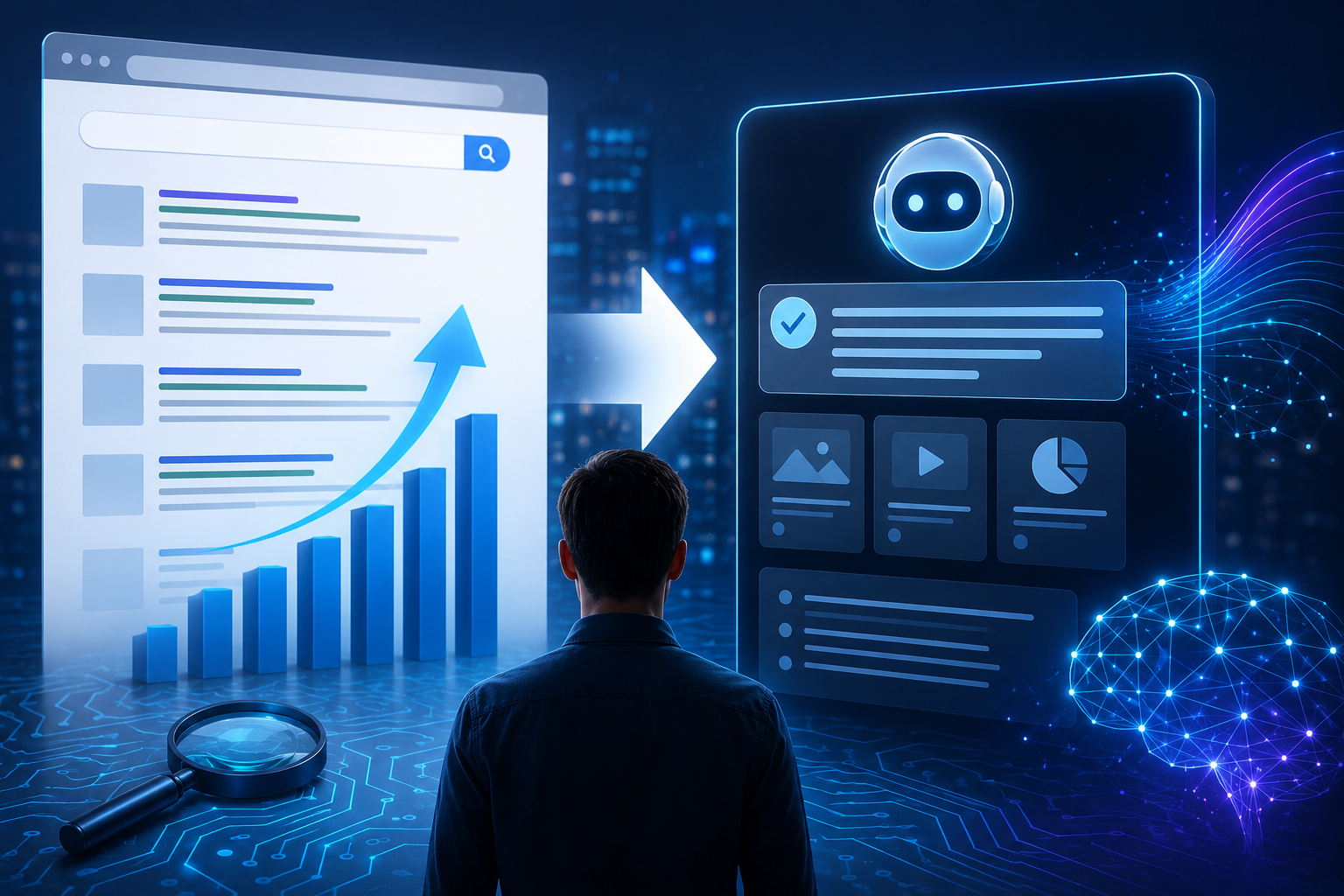
There has been a paradigm shift in digital visibility. No longer is it sufficient to have visibility within the first page; modern search engines powered by AI technologies are providing instant responses and AI-powered summaries that can bypass traditional links. This includes AI layers in the search engines of Google, Microsoft, and OpenAI (“AI Overviews” and “AI Mode” of Google, Bing’s Copilot Search, and the built-in search engine of ChatGPT). There is an influx of customers towards these technologies: as per a study by McKinsey, around 50% of searches on Google contain AI-powered summaries.
Crucially, when AI answers appear, users stop clicking. Pew Research found that only 8% of searches with a Google AI summary produce a click on a link, about half the click-through rate when no AI answer is shown. In other words, the search “answer” itself is becoming the product. This means brands must rethink visibility: it’s about being cited by AI as the source of truth, not just appearing in the old blue-links list.
The Rise of AI-Powered Search
The leading firms have clearly signaled their intention that search will become more interactive and AI-powered. To illustrate, Bing on Microsoft has integrated Copilot AI “to blend the best of traditional and generative search” and provide users with “easy-to-digest summaries [that include] well-cited sources.” The platform will supply AI-driven answers along with images, videos, and links, minimizing scrolling. On its part, Google has introduced such AI-driven features as AI Overviews and AI Mode for handling complex searches.
These technologies incorporate retrieval-augmentation generation by extracting data from several websites, summarizing, and citing it. In addition, OpenAI has come up with ChatGPT Search that “[enables] people to connect to original, high-quality content from the web via chat.” In effect, search is becoming an AI-powered answering machine that allows users to pose questions and receive real-time answers from publishers’ materials.
The above changes have already affected consumer behavior. According to a survey conducted by McKinsey at the end of 2025 involving approximately 2,000 U.S. consumers, half of them use AI search engines and consider them as their main tool for research purposes. Moreover, according to their forecast, $750 billion in U.S. retail sales will be affected by AI search by 2028. Nowadays, billions of Google search engine results already contain the AI answer box. As Google itself states, “user preferences are quickly evolving towards generative AI.” Still, the company recommends that website owners stick to SEO best practices, since “best practices for SEO continue to be relevant,” as stated in Search Central guidance, because “Google’s AI answers are based on the same index of high-quality pages.”
From Clicks to Answers: The AI Search Impact
The introduction of the AI interface poses a threat to existing traffic flow. According to industry statistics, if there is an answer at the top, then most people do not go further and look for links below the screen. In one case, a creative agency had a drop of 40% traffic within half a year despite proper keyword ranks because AI answers and knowledge panels were taking away clicks. It turned out that Google Overviews and featured snippets made about 60% of searches finish without any clicks.
In recent studies, this trend is confirmed. As reported by Pew in their browsing statistics, only 8% of searches are followed by clicking on a link when there is a Google AI summary, while it is 15% without such a summary. At the same time, 75% of users never scroll to the bottom of the screen beyond the answer provided by AI.
However, for brands, the emergence of “zero click” introduces new threats. McKinsey estimates that those who are not prepared to face the new challenge can lose from 20 to 50 percent of the traffic that used to go to them via search. In addition, while the sources of information for the regular search engines include only branded websites, the sources for generative AI include a wide variety of materials, with 5-10 percent of the data coming from the website of a particular company.
It means that well-known brands can actually disappear from AI search results. As McKinsey notes, even the leading brands can be ignored by AI answers, despite their dominance in conventional search results. Your branded search engine results page (SERP) on Google can feature your website, but the AI summary may cite some forums or media.
Case Studies: Winning the AI Answer Game
Some organizations are already adapting effectively. Consider Xponent21, a small digital agency in Virginia. Its CEO noticed organic traffic plunging even as keyword ranks were “healthy.” A deep dive revealed the issue: AI overviews and chatbots were answering queries without ever sending visitors to Xponent21’s site. To fight back, the team created a single AI-optimized guide targeted at their key question (“how to rank in AI search results”). Crucially, the article led with a clear answer in the first 50–100 words, used explicit H2 headings (since AI models use heading hierarchy), and added schema markup and citations.
The results were dramatic: within weeks, their content became the #1 answer on Perplexity AI for that query, and impressions spiked 80× with organic traffic rising 18×. The article even notes that afterward, “they became the cited authority whenever AI tools answered questions about AI search optimization.” In other words, by writing content that AI systems could parse as a direct answer, the agency turned invisibility into leadership in the AI answer landscape.
This is because content that answers questions readily takes precedence over other types of content in generative searches. In another analysis involving 150,000 pages, it was discovered that original research and data-driven content get cited more often by artificial intelligence than typical how-to guides. In this instance, typical blog posts in education that included “top 10” type of posts made up only 12% of AI citations, while trends and data attracted citations about 78% of the time.
Similarly, the top 10 SEO posts in their sample got 55% of organic traffic compared to 29% AI generated traffic. Almost 50% of the best SEO performing posts received no AI traffic at all. It is important to note here that content that ranks the highest on Google may not necessarily rank highly when AI comes into play. Brands need to design content specifically for an AI answer format concise and factual.
Strategies for the AI Search Era
This is a very important question for marketing and SEO professionals. The strategy needs to go beyond the old-fashioned approach to ranking. Google has made it clear that its “SEO best practices,” such as useful, user-centric content, proper website structure, and so forth, are still at the core of the whole thing.
However, nowadays, it is important not only to follow Google’s advice but also to make your content attractive for AI. In other words, it should be packed with answers, contain a logical hierarchy, and consist of verifiable facts. As it follows from the recommendations by Google, it is necessary to work on “unique, compelling” content with an authoritative voice. Original information, case studies, and analysis cannot be copied by AI.
Another emerging concept is Generative Engine Optimization (GEO) or Answer Engine Optimization (AEO), essentially SEO adapted for AI. McKinsey and others argue that brands will need to account for the broader “knowledge graph” that AI taps into. For example, the Harvard Business Review notes luxury brands face a unique risk: LLMs may misinterpret brand cues unless companies “seed authoritative language in owned and earned media”. In practice, this means structuring product and brand content so machines understand it, and ensuring the brand’s narrative is present in third-party sources as well.
Public relations and content marketing now have a frontline role. Authority and trust signals, traditionally a PR domain, are critical for AI visibility. As communication strategist Gini Dietrich observes, AI answers are built on “authority, trust, [and] consistent mentions” across the web. SparkToro research likewise shows that brand mentions in quality publications are the top correlate of AI visibility.
Simply put, if your brand, executives, or products are consistently covered and cited in reputable media, AI systems are more likely to pick them up as sources. This is the heart of Digital PR: earning authoritative coverage so that a brand becomes “the answer, not the ad next to it”. For instance, placing expert quotes in industry reports or getting features in high-authority outlets can directly translate to AI citations.
Finally, monitoring AI visibility demands new tools and metrics. It’s no longer enough to track Google rankings. Forward-looking organizations are testing how they fare in AI responses by asking chatbots about their brand or category and noting who gets cited. Some agencies even measure “AI visibility scores.”
While such metrics are still evolving (and, as SparkToro notes, can be inconsistent if AI answers fluctuate), the key is to ensure your brand is on the map in the AI training data. If you’re not being cited today, that may mean adjusting content strategy to target the exact user intents that AI answers, and building more high-quality mentions around those topics.
Conclusion
Generative AI is altering the definition of visibility online. The old notion of SEO, which was defined by clicks, is no longer valid. The new notion is to be considered the source to turn to for help provided by AI assistants. However, that does not mean that SEO is not relevant anymore since Google stresses the need for proper indexing, crawlability, and valuable content. Nevertheless, it raises the bar. Companies need to start considering themselves as answer providers, producing concise and reliable content that will be the answer itself. It implies having a full-fledged website presence that is based on credible sources gained via PR and partnerships. It was constantly highlighted by the industry experts that the two main components of success in AI search are authority and trust.